The 'Look But Don't Touch' Design: Safe Viewing Windows for Cats
The Sushi Bar of Small Pet Ownership
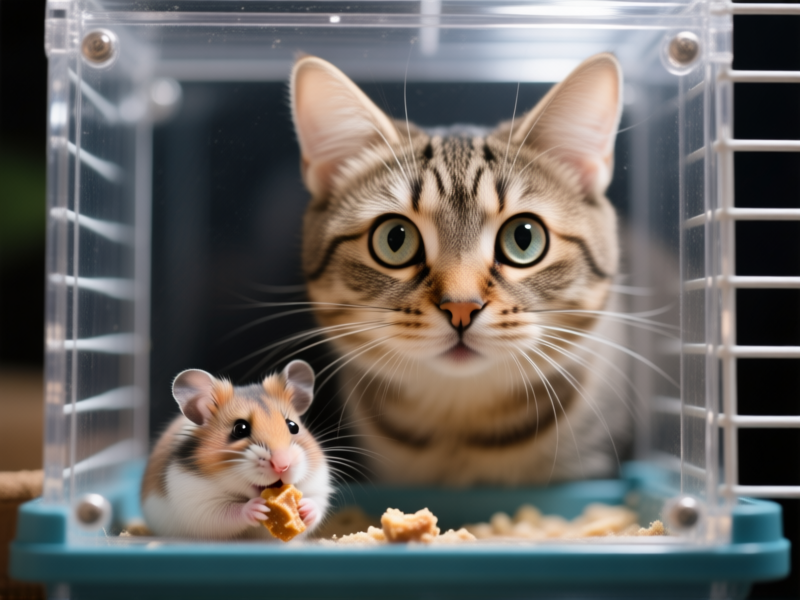
Okay, let's be brutally honest for a second. We love our cats. We love our hamsters (or gerbils, or mice). They are not friends. They are an "iffy roommate situation" at best, and a nature documentary climax waiting to happen at worst. You feel this guilt. You've got this amazing predator living with the world's cutest potential prey. You want your cat to be entertained—it's boring staring at the same wall all day!—but not, you know, successful . That's where the viewing window comes in. It's not just a piece of plastic. It's a peace treaty. A tiny, transparent Sushi Bar where your cat can watch the little "conveyor belt" of hamster life roll by, forever just out of reach. Beautiful.
Why Your Cat is a Masterclass in Window Shopping

We call it "behavioral enrichment." Sounds fancy, right? It's just giving your pet's brain a job. For cats, hunting is the ultimate job. But modern life doesn't come with a lot of mice. So a viewing portal gives them the first—and most mentally taxing—phase of the hunt: the stalk . The observation. The plotting. That intense focus is like a CrossFit workout for their brain. It burns nervous energy. It satisfies a deep instinct. And the best part? It always ends in a stalemate. No prize, no guilt, just a tired, mentally satisfied cat. They get the thrill of the chase without the messy cleanup. It flips a problem into a puzzle.
Glass vs. Plastic vs. Screens: The Safe Viewing Showdown
Here's the thing: not all windows are created equal. Your cat will test it. Oh, they will test it. So you need something that won't shatter, flex too much, or get shredded.
Tempered Glass:
The heavyweight champ. Incredibly scratch-resistant and sturdy. But heavy, and if you drop it during a DIY project... it's over.
Clear Acrylic (Plexiglass):
The DIY darling. Light, easy to cut, and shatterproof. The downside? A determined cat can eventually scratch it up, making the view foggy over time. Go thick—at least 1/4 inch.
Metal Mesh or Screen:
Great for airflow, terrible for the "aquarium effect." It doesn't provide that crystal-clear, immersive view, and tiny claws can get caught. Use it for ventilation, not the main event.
The "Cat-Proof Cage" Checklist (It's All About the Edges)
You can have the best window in the world, and a cat will find the weak spot. They're fuzzy little engineers of chaos. So your design needs to be obsessive.
Seals & Seams:
The gap where the window meets the cage is the enemy. You need a tight seal, secured from the *outside* with screws and washers, and then sealed on the inside with a non-toxic aquarium-grade silicone. No pin-head gaps.
Latches:
Flush-mounted. Slide-bolts. Something that can't be batted open by a clever paw. Think "toddler-proof," but for a creature with knives on its feet.
Location:
Put the window on the side, not the top. A top-mounted window turns the cage into a TV, sure, but it also turns the lid into a launchpad. Side view keeps everyone's roles clear: cat is observer, small pet is not a ceiling toy.
Your Weekend DIY: Building a Better Window
Feeling handy? Good. This is a Saturday project with a huge payoff. You'll need: a sheet of 1/4" clear acrylic, a jigsaw or scoring tool, a drill, some short machine screws, washers, and non-toxic aquarium silicone.
1.
Measure Twice.
Seriously. Mark your cut on the acrylic's protective film.
2.
Cut Slow.
Use a fine-tooth blade on the jigsaw or score and snap it. Sand the edges smooth—sharp plastic is a no-go.
3.
Drill & Mount.
Drill pilot holes through the acrylic and the cage wall. Secure it from the outside with screws and washers. This makes the interior smooth.
4.
The Magic Seal.
From the *inside*, run a thin, clean bead of aquarium silicone around the entire seam. Smooth it with a wet finger. Let it cure for 24 hours before introducing any pets. This seals microscopic gaps and makes it cleanable.
Watching the Watchmen: Setting House Rules
Installing the window is just tech. The real work is managing the behavior around it. You're the referee.
Never let the viewing become obsessive or stressed. If your cat is fixated, swatting constantly, or causing the small pet to hide, it's time-out time. Distract them. Cover the window for a while. You want calm observation, not frantic pawing.
Make it rewarding. Sometimes, give your cat a treat when they're sitting calmly by the window. They start to associate "watching the hamster TV" with good things that happen to
them
. It's about coexistence, not torment. When it works, it's pure magic. A quiet house, a mentally tired cat, and a small pet living its best, unbothered life. That's the win.